How to Choose Security Lighting for Commercial Properties?
We begin commercial security-lighting selection with a site assessment. It should identify activity zones, blind spots, camera requirements, mounting options, and potential effects on neighboring properties. Effective lighting plans favor consistent illumination, zone-specific fixtures, responsive controls, and code compliance rather than excessive brightness.
Key Takeaways
- We assess entrances, parking areas, loading docks, walkways, perimeters, service zones, and camera coverage before choosing fixtures.
- We use even light distribution, proper mounting heights, and suitable beam patterns to limit dark areas and glare.
- We match fixture types to each zone, including floodlights for focused coverage, wall packs for doors, canopy lights for covered spaces, and pole lights for parking areas.
- We use photocells, timers, dimming, and motion sensors to maintain needed after-hours visibility while reducing energy consumption.
- We review shielding, light-trespass risks, durability, maintenance access, local ordinances, electrical codes, and permit requirements before installation.
Start With a Property Security-Lighting Assessment
Security lighting for commercial properties starts with a site assessment, not a fixture catalog. We first identify where people, vehicles, deliveries, and security activity occur after daylight fades.
Coverage commonly includes entrances and exits, parking lots, walkways, loading docks, dumpster areas, service yards, building perimeters, gates, stairways, signs, and known blind spots. Each area needs a separate review against operating hours, foot traffic, vehicle traffic, existing shadows, camera placement, neighboring properties, roadway proximity, and practical mounting locations.
Lighting supports visibility, wayfinding, surveillance, and deterrence. It cannot guarantee crime prevention or remove every safety risk. A storefront, warehouse, office campus, industrial facility, and parking lot each require different coverage patterns, fixture heights, controls, and light distributions.
Assessment checklist
Before selecting outdoor security lighting for business, we should document the following:
- Areas that need coverage, including perimeter gaps and hidden service zones.
- Hours when each space must remain illuminated.
- Camera locations and whether current lighting supports usable footage.
- Existing shadows, glare, dark corners, and uneven illumination.
- Available poles, walls, canopies, roofs, and other mounting points.
- Nearby residences, businesses, roads, sidewalks, and property lines.
- Electrical infrastructure, circuit capacity, and control wiring options.
- The party responsible for fixture inspections, cleaning, repairs, and replacements.
A professional site review helps us turn those notes into a practical layout. Our commercial lighting installation service can evaluate coverage needs before fixture selection creates costly gaps or excess spill light.
Prioritize Even Coverage Over Maximum Brightness
Commercial security lighting should provide consistent visibility, not the highest possible output. Excessive brightness can produce glare, create harsh contrast, and make shadows appear darker around the illuminated area.
Lumens measure the amount of light a fixture produces. Watts measure the energy a fixture consumes. LED fixtures generally produce substantial light output while using less energy than older lighting technologies, which makes lumen output and light distribution more useful selection factors than wattage alone.
We determine brightness requirements by reviewing the area’s purpose, mounting height, beam distribution, camera use, local codes, project specifications, and recognized lighting guidance. Parking areas need broad, even coverage. A loading dock may need stronger task visibility at truck access points. A side entrance may need controlled wall-mounted light that avoids shining into nearby windows.
Uniform illumination matters because eyes and cameras need usable contrast. Proper aiming, suitable mounting heights, adequate fixture spacing, and the right optical pattern help reduce dark gaps without flooding an area with unnecessary light.
Color temperature also affects the final result. Lighting in the 3000K–4000K range may suit many commercial settings because it provides clear visibility while maintaining a comfortable appearance. Cooler color temperatures may suit certain camera-performance or visibility needs. They are not always the best choice, since overly harsh light can affect comfort, curb appeal, and adjacent properties.
For projects replacing aging fixtures, LED retrofit upgrades can improve output control, reliability, and operating efficiency without treating brightness as the only security measure.
Match Fixture Types to Each Commercial Area
LED floodlights, wall packs, and pole lights all serve different functions. We select fixture types based on the zone, mounting options, target area, required distribution, and surrounding conditions.
LED floodlights work well for loading docks, gates, service yards, building perimeters, and targeted blind spots. Their flexibility makes them useful for focused coverage, but poor aiming can cause glare, light trespass, and roadway distraction.
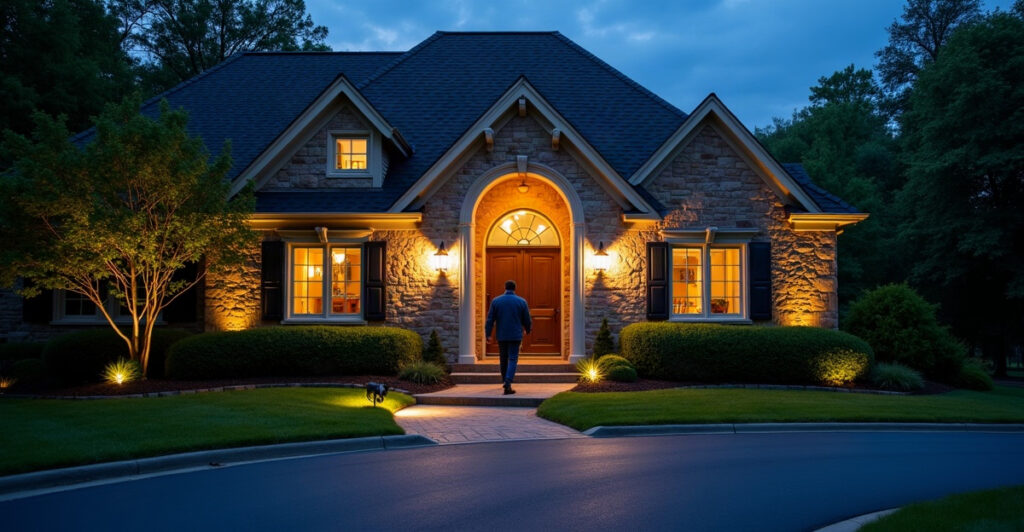
Wall packs fit exterior doors, exits, entrances, side passages, and building-mounted perimeter zones. They place light close to the structure and can support clear access around doors and service entries.
Canopy lights work effectively beneath covered loading areas, awnings, parking structures, drive-throughs, and sheltered pedestrian zones. Their optics should distribute light across the covered space without creating hot spots near the fixture.
Pole-mounted area lights suit parking lots, open campuses, larger vehicle areas, and wide perimeters. Pole height, spacing, fixture output, beam pattern, and property-line distance all affect performance. A poorly planned pole layout can leave dark lanes between bright pools of light.
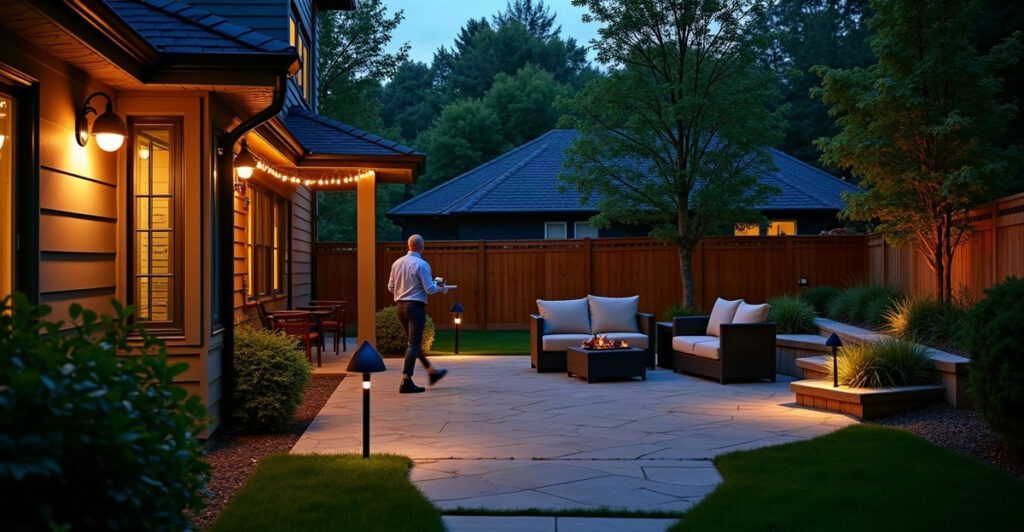
Bollards and path lights support walkways, landscape edges, pedestrian routes, and wayfinding. Lower-level fixtures can improve route visibility without relying on high-mounted fixtures alone. Our landscape accent lighting approach can help define pedestrian paths and exterior features while keeping security objectives in view.
Motion-activated fixtures suit lower-traffic gates, dumpster areas, service zones, and after-hours loading spaces. We avoid using them in locations where frequent activation would distract employees, tenants, neighbors, or drivers.
Mounting height and beam distribution determine how much area each fixture covers. Higher mounting can spread light farther, yet it may reduce light at ground level or increase spill beyond the property. Lower mounting can provide focused visibility but may require more fixtures. We review existing electrical infrastructure and mounting feasibility before choosing equipment or requesting quotes.
For additional ideas on exterior coverage near entry points, our front-of-house lighting guide shows how layered lighting can support access and visibility.
Use Controls to Balance After-Hours Security, Energy Use, and Light Pollution
Controls let us keep essential areas illuminated while reducing unnecessary overnight operation. The right control plan should reflect business schedules, tenant needs, camera visibility, maintenance capability, and after-hours activity.
Photocells provide dusk-to-dawn operation and work well for perimeter fixtures, parking areas, exterior doors, and primary walkways. Astronomical timers adjust schedules based on seasonal sunset and sunrise times, which helps maintain predictable operation without frequent manual updates.
Motion and occupancy sensors work best in infrequently used service areas, gates, storage yards, and loading zones. We should avoid sensor-only lighting in active or high-risk areas where sudden darkness could affect safety, cameras, or site operations.
Dimming schedules can reduce parking-lot and walkway output after business hours while preserving appropriate visibility. Instead of switching an entire site off, we can maintain lower background illumination and raise light levels where activity occurs.
Networked controls add centralized scheduling, fixture grouping, monitoring, and site-wide adjustments. They can help facility teams identify outages, adjust seasonal schedules, and manage multiple zones from one system. Our smart lighting automation service helps establish control strategies that support security without wasting energy.
For further context on connected exterior systems, review the benefits of smart outdoor lighting and practical smart lighting design ideas. The same principles of scheduling, zoning, and responsive operation can inform commercial projects.
Reduce Glare, Light Trespass, and Neighbor Impacts
Poorly aimed security fixtures can make a property harder to see. Glare may obscure people, obstacles, pavement changes, or camera details while disturbing adjacent businesses, residences, pedestrians, and nearby drivers.
We reduce glare and light trespass through proper fixture selection and layout. Full-cutoff or correctly shielded fixtures can direct light downward where appropriate, especially near roads, property lines, residential areas, and pedestrian spaces.
Aiming fixtures carefully prevents light from projecting above the intended target. Beam angles, mounting heights, spacing, shields, and lower-output targeted fixtures all help control spill light while maintaining useful coverage. A focused floodlight may solve a blind spot more effectively than increasing output across an entire wall or parking area.
Before installation, we should evaluate effects on neighboring properties, public rights-of-way, adjacent buildings, and roadways. Municipal requirements may limit fixture output, uplight, shielding, operating hours, or light levels at property boundaries.
Brighter is not always safer. Effective security lighting helps people and cameras see clearly without forcing eyes to adjust between intensely bright and very dark zones. For residential-adjacent commercial sites, our security lighting ideas also offer useful guidance on placing fixtures with controlled coverage.
Check Durability, Maintenance, and Compliance Before Choosing Fixtures
A fixture that performs well on installation day must also withstand weather, impacts, dirt, vibration, and routine use. We evaluate wet-location ratings, relevant IP ratings, impact resistance, corrosion resistance, lens-cleaning needs, LED driver serviceability, warranty coverage, and expected service life.
Maintenance planning should account for pole access, lift equipment, building height, fixture locations, replacement part availability, and safe repair procedures. A high-output pole fixture may look cost-effective at purchase, yet access costs can change the long-term value if every repair requires specialized equipment.
Local compliance also needs review before work begins. Municipal lighting ordinances, dark-sky rules, zoning restrictions, electrical codes, permit requirements, and accessibility or pathway-illumination standards may differ by municipality and property type. Requirements can also vary based on parking areas, pedestrian routes, nearby homes, environmentally sensitive locations, and road proximity.
We recommend confirming permits and technical requirements before ordering equipment. A qualified security lighting installation team can help align the design with site conditions, maintenance needs, and applicable requirements.
For a clearer decision process, compare professional planning with self-managed work in our DIY versus professional lighting guide. Commercial properties often benefit from expert design because fixture placement, controls, electrical capacity, and compliance all affect long-term performance.